RESILIENT COASTS FOR SALMON SPOTLIGHT COMMUNITIES
Cordova Bay
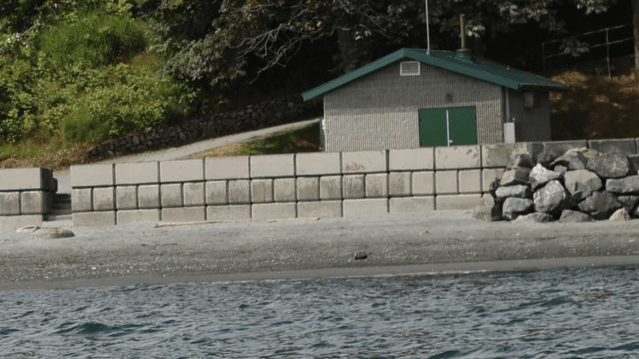
Cordova Bay is a seaside community on the eastern shores of the Saanich Peninsula. Its wide, gently sloping sandy beaches provide ideal habitat for forage fish species, and, alike, have made it an appealing place for human settlement. Extensive residential development has transformed much of the shoreline, bringing with it human-made structures designed to prevent erosion and protect property. Over time, this shoreline hardening has had cumulative and damaging effects on this ecologically significant area, accelerating erosion and leading to the loss of native vegetation and natural habitat.
For the purposes of the Resilient Coasts for Salmon initiative, the Cordova Bay study area covers 4 km of marine shoreline along Haro Strait, with data derived from imagery collected up to 2022.
Cordova Bay lies within the traditional territories of the W̱SÁNEĆ and Lekwungen peoples, and is home to the ancient village site of ȾEL¸IȽĆE (c̓əl̓íɫč in Lekwungen).
Key Findings
Shoreline Modifications
Man-made structures like seawalls and riprap, often built to protect shoreline infrastructure, can actually exacerbate erosion by redirecting wave energy to nearby areas. These modifications also remove key intertidal habitats and food sources essential for the growth and survival of juvenile salmon and forage fish. By stripping away the natural complexity of coastal ecosystems, shoreline modifications reduce their capacity to support biodiversity and adapt to rising sea levels.
Extent of shoreline modification
As of 2022, approximately 2.4 km of Cordova Bay’s shoreline has been modified, while 2 km remains natural. This indicates that roughly 53.4% of the community’s shoreline is classified as modified – Figure 1.
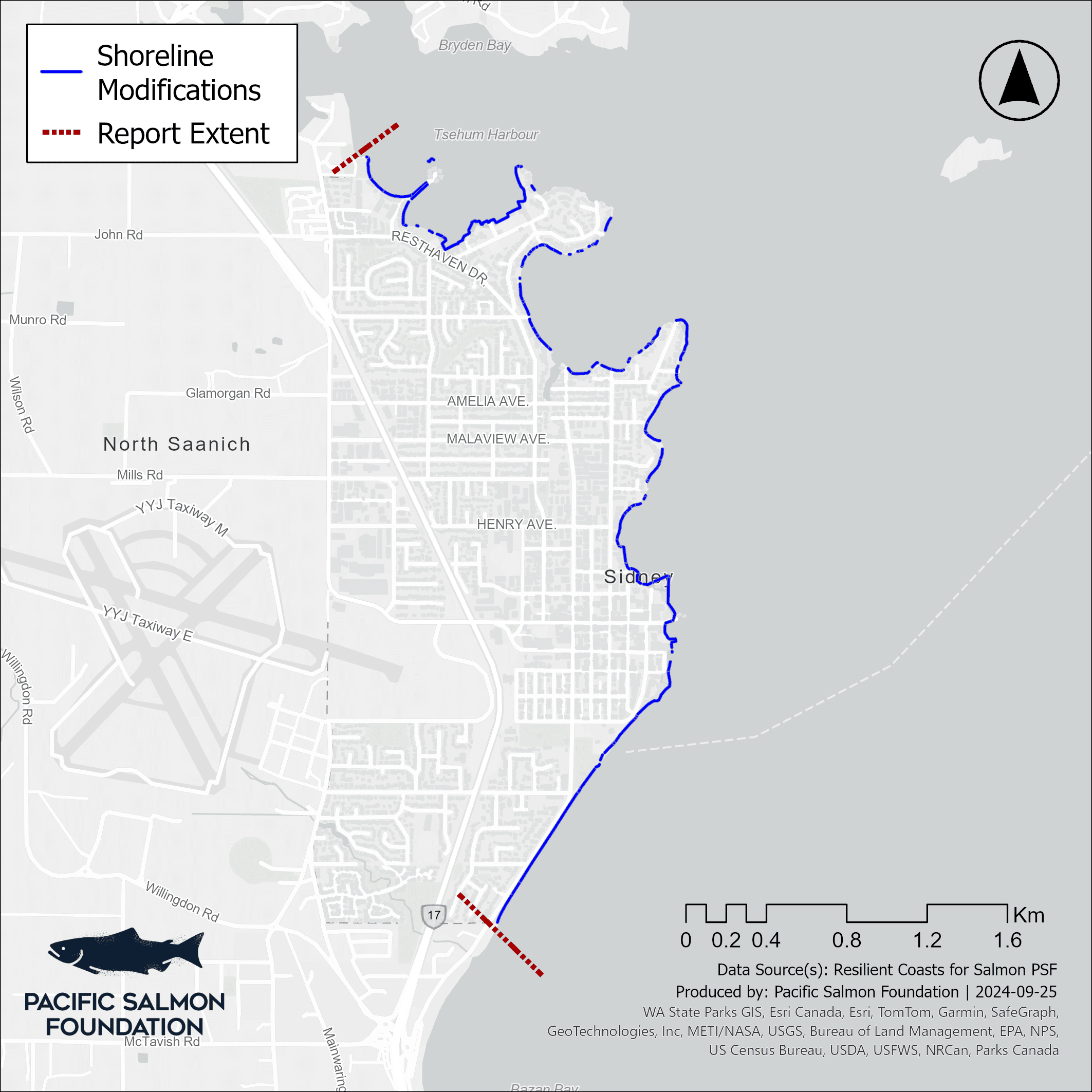
Figure 1. Coastal modifications (shown in blue) with the extent of data collection outlined by red dashes.
Most common shoreline modification types
The most common modification types were seawalls/bulkheads (53.6%), riprap (38.6%), and beach access (path/stairs) (5.0%) – see Figure 2.
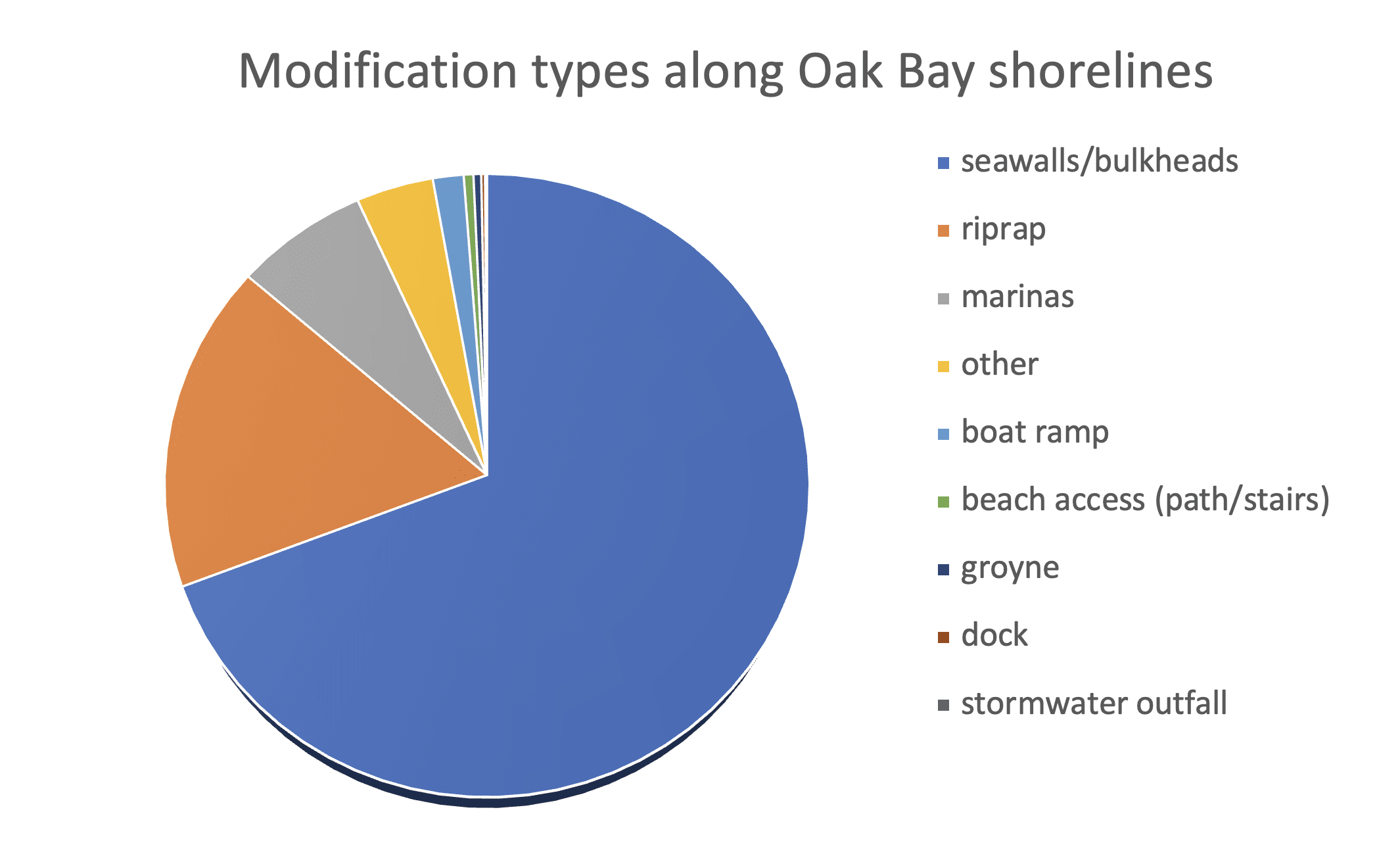
Figure 2. The percentage of modified shoreline by modification type.
Most common materials used in shoreline modifications
The materials most commonly used for shoreline modification were concrete (47.7%), rock (38.2), and wood/creosote wood (7.4%) – see Table 1. The unknown/undefined category indicates that the recorder was not able to determine the material that was used, due to issues with image clarity or obstruction, or in cases when a mix of materials were used.
Table 1. The percentage of modifications, based on the type of material used in the modifications.
| Material | Percentage of Modifications |
| Concrete | 47.7 |
| Rock | 38.2 |
| Wood/Cresote Wood | 7.4 |
| Unknown/Undefined | 2.6 |
| Masonry | 4.1 |
Mobility of logs
The vast majority (95.7%) of shoreline segments had both anchored and mobile logs present. A small portion (1.7%) of the shoreline had only mobile logs present.
Overwater Structures
Overwater structures, like docks and piers, cast heavy shade that degrades nearshore habitat. Juvenile salmon avoid these shaded areas, which alters their natural foraging and migration patterns by forcing them into deeper waters. There, they expend more energy and face greater predation risk. The reduced light also limits the growth of essential habitats like eelgrass and algae, along with the diverse communities they support.
Number of overwater structures total and by type
As of 2022, there are no overwater structures found in the community of Cordova Bay.

Figure 3. The extent of overwater structures within Cordova Bay.
Log Accumulation
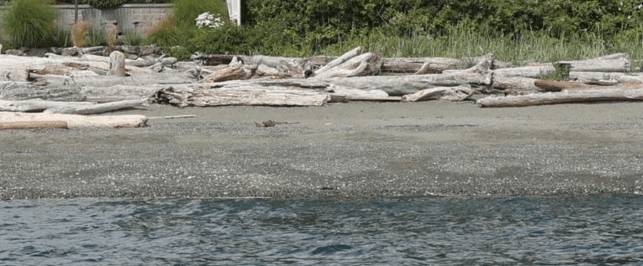
While logs are a natural part of coastal ecosystems, the escape of modified logs from log booms is leading to excessive accumulation. These logs can scour beaches, altering sediment composition and smothering nearshore vegetation. Unlike natural logs, modified logs are stripped of root balls and branches, making them unstable and prone to rolling across critical habitats that juvenile salmon and forage fish rely on for growth, food, and shelter.
Extent of log accumulation
Of the total shoreline, approximately 2.9% (130 m) of the shoreline was found to have an extreme (>89%) accumulation of logs, with another 11.9% (535 m) with high accumulations (50 to 89% coverage), and 17.3% (780 m) having moderate levels (20% to 49%) of the beach covered by logs – see Table 2. It should be noted that the moderate log accumulation category also represents a significant coverage of logs – whereby 20-49% log coverage on a given beach could negatively impact shoreline habitat.
Table 2. The length of shoreline (in percentage and metres) by category of log accumulation.
| Log Accumulation | Percentage of Shoreline | Metres |
| Extreme (>89%) | 2.9 | 130 |
| High (50 to 89%) | 11.9 | 535 |
| Moderate (20 to 49%) | 17.3 | 780 |
| Low/None (<20%) | 67.9 | 3,053 |
Mobility of Logs
The vast majority (95.7%) of the shoreline segments had both mobile and anchored logs present as part of their log accumulation.
To access and download the Resilient Coasts for Salmon layers for Cordova Bay, click here.